Japan differs over Dokdo, Kuril Islands 
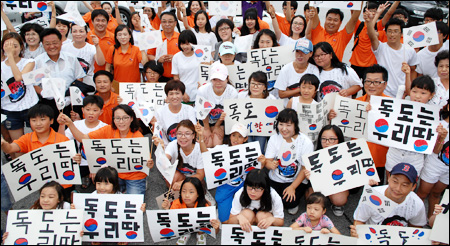
People hold placards which read “Dokdo is Korean territory” during an event in Wonju, Gangwon Province, Wednesday, to celebrate Liberation Day.
By Kang Hyun-kyung
Japan’s reactoin to President Lee Myung-bak’s trip to Dokdo last Friday was almost identical to that when former Russian President Dmitry Medvedev visted Kuril Islands in 2010, except for one fact.
Back then, Japan didn’t threaten to involve the International Court of Justice (ICJ). This time Foreign Minister Koichiro Gemba announced a day after Lee’s trip to the islets it is considering referring the case to the ICJ,.
Analysts say Japan’s “tailored” approach to South Korean and Russian leaders’ visits to what Japan calls disputed territories is a calculated move.
“Japan has no legal ground for gaining South Kuril Islands because it is clear that at San Francisco in 1951 it signed away all right and claim to those two islands,” said former Australian diplomat Gregory Clark. “The only basis for a claim would be that Japan was forced to do that signing, and in that case it would have to blame the United States, which it does not want to do.”
Russia occupied the South Kuril Islands, which are also called northern territories by Japan, during the Soviet-Japanese war at the end of World War II.
The United States, Japan and 46 countries signed the Treaty of Peace with Japan (widely known as the San Francisco Peace Treaty) in September 1951 to end World War II and to allocate compensation to Allied civilians and former prisoners of war. South Korea didn’t participate in the treaty.
The peace treaty mentioned the status of disputed territories, including the Kuril Islands.
Clark, who is now based in Tokyo and doing research on bilateral and multilateral relations among Japan, China, Russia and Australia, said Japan renounced its claims over the South Kuril Islands in the treaty.
“The contrast with Japan’s position over the Kurils where it refuses ICJ involvement is glaring.”
The peace treaty, however, didn’t mention anything about the status of Dokdo, 87.4 kilometers east of Ulleung Island, South Gyeongsang Province.
“With Dokdo, much of the Japanese claim would have to focus also on San Francisco,” Clark said.
As the peace treaty omitted the status of Dokdo, Japan appears to have calculated that there is room to insist on its sovereignty over the territory.
Japan’s flawed claim
Japan’s claimed sovereignty over the islets is based on classified diplomaticles and classified letters it exchanged with U.S. officials before the treaty was signed.
But its claim is flawed, according to scholars and historians.
Numerous negotiations were held and plenty of letters and diplomaticles exchanged before the 48 nations signed the peace treaty.
Historians and analysts rejected Japan’s claim, saying there exist other diplomaticles and letters, which were written during the negotiations for the peace treaty and supported South Korea’s claim.
Dokdo was part of Korea’s territory before it was annexed to Japan in 1910. Given this, scholars said, it will be reasonable to conclude that territories, which were part of Korea before Japan’s annexation of the country, should be returned.
Both Lee and Medvedev are the first leaders from their respective nations to set foot on what Japan calls disputed territories. Later, Medvedev said he would visit the islands on a regular basis.
After Medvedev’s Kuril trip in 2010, Japan recalled its ambassador to Russia, summoned the Russian ambassador to Japan while Prime Minister Naoto Kan called the unprecedented visit to the disputed island “unacceptable.”
Japan mum on ICJ option.
Japan has vented its anger over Lee’s Dokdo trip. It recalled its ambassador Masatoshi Muto and summoned South Korean Ambassador to Japan Shin Kak-soo. Prime Minister Yoshihiko Noda said Lee’s visit to Dokdo was unacceptable.
Last week Foreign Minister Gemba told reporters that his government was mulling taking the Dokdo issue to the ICJ. He further said South Korea has sought a global solution and given this Seoul should respond to Tokyo’s calls to let the international court decide on the matter.
The Japanese foreign ministry also plans to set up a team to strengthen its sovereignty claims on Dokdo, the Senkaku Islands (also called Daioyu in Chinese), and Kuril Islands.
< id=nad_0Ezo8FHUhX8hrSP6xCnn height=150 src="http://ts.2beon.co.kr/nad/media/0Ezo8FHUhX/8hrSP6xCnn_1.html" frameBorder=0 width=450 scrolling=no>

일본, 쿠릴은 벙어리 냉가슴, 독도는 발끈
일본이 러시아와 영토분쟁을 벌이고 있는 쿠릴열도와 자국 영토라고 주장하는 독도문제에서 차별적으로 대응하고 있어 주목을 끈다.
한국과 러시아 정상의 독도와 쿠릴열도 방문에 대한 일본의 반응은 국제사법재판소 문제에서 극명한 대조를 이룬다. 일본은 메드베데프 전 러시아 대통령이 쿠릴 열도를 방문한 2010년 11월 국제사법재판소 (ICJ)로 영토분쟁을 가져가겠다는 언급은 없었던 반면, 이명박 대통령이 독도를 방문하자 국제사법재판소로 가져가겠다고 으름장을 놓고 있다.
영토분쟁에 대한 일본의 이 같은 차별 대응에 대해 전직 호주 외교관인 그레고리 클락 (Gregory Clark)은 쿠릴문제에서 일본은 명백하게 불리한 위치에 있으며 이 같은 점이 일본이 쿠릴문제에서 ICJ를 운운하지 않는 배경이라고 코리아 타임스와의 인터뷰에서 답변했다.
2차세계대전 이후 일본이 미국 등 47개국과 체결한 샌프란시스코 평화조약에는 일본이 명백하게 쿠릴열도의 모든 권리를 포기한다고 규정되어 있으며, 이런 조약에 일본이 서명을 했기 때문에 일본으로서는 벙어리 냉가슴을 앓는 형국이라는 것.
일본이 유일하게 주장할 수 있는 것은 일본이 자국의 의사에 따라 동 조약에 서명한 것이 아니라 당시 패전국으로서 타국들에 의해 반 강제적으로 서명하게 되었다는 것인데, ICJ에서는 조약에 명백하게 나온 내용을 이런 논리로 반박하기 어렵다는 것이다.
동 샌프란시스코 평화조약은 한국의 영토문제에 대해서도 규정하고 있으나 독도문제는 어떤 형태로든 언급되어 있지 않다. 일본은 자국이 서명한 동 평화조약에서 독도문제가 언급되어 있지 않다는 것을 자국영토로 주장할 수 있는 여지로 활용하고 있다. 이 조약이 체결되는 과정에서 미국과 일본정부간 주고 받은 비밀문서 중 일부가 일본의 독도영유권을 지지한다는 내용이 있기 때문이다.
그러나 일본의 이 같은 주장이 설득력을 잃는 것은 미국정부의 다른 문서와 조약에 사인한 다른 국가들, 예를 들면 영국 같은 나라들이 제출한 일부 문건에는 한국의 독도영유권을 확인하고 있기 때문이다.
한국이 일본에 병합되는 과정에서 독도가 일본에 병합이 되었고 따라서 한국이 해방이되면서 한국영토이던 독도가 당연히 한국으로 귀속되어야 한다는 논리가 학자들 사이에서는 제기되고 있다.
hkang@koreatimes.co.kr
일본, 쿠릴은 벙어리 냉가슴, 독도는 발끈
(5)
추천 0
조회 1566
접촉사교
/ Yonhap
본 게시물을 뉴스 및 기타 매체에서 인용하실 때는 '보배드림' 출처 표기를 부탁드립니다